Why Aboriginal Women Are Still Paying the Price for “Inclusion” in Public Sector Workplaces
What does it mean to be included in a workplace that was never designed for you?
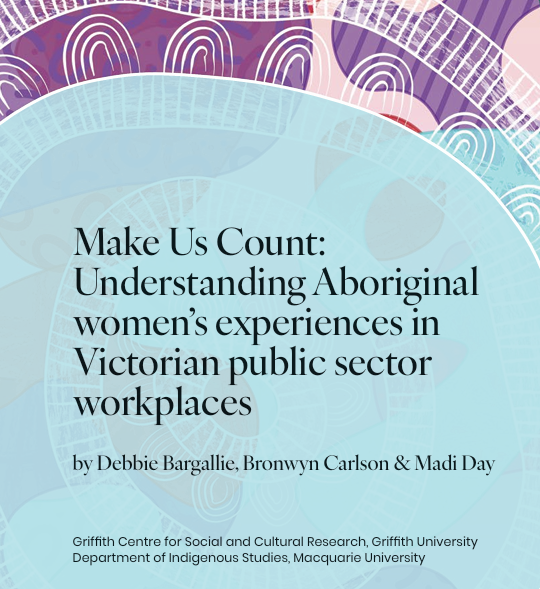
The Make Us Count report—authored by Aboriginal scholars Debbie Bargallie, Bronwyn Carlson, and Madi Day—offers a powerful, unflinching answer. Drawing on Indigenist and intersectional methodologies, the report centres the voices of Aboriginal women working in the Victorian public sector and exposes a stark truth: increased representation has not translated into justice, safety, or equity.
Despite decades of diversity strategies, Aboriginal women continue to experience racism, misogyny, exploitation, and institutional indifference as everyday features of their working lives. The report makes clear that these are not isolated incidents or “bad apples”, but structural conditions produced by bureaucratic systems that reward compliance, silence dissent, and normalise racialised gendered harm.
Counting bodies, not valuing lives
One of the report’s most damning insights is the way Aboriginal women are treated as numbers rather thans(hohawnher than as workers with expertise, aspirations, and futures. Participants repeatedly describe being hired into precarious roles, stalled at the lowest rungs of organisational hierarchies, and denied pathways to progression—while simultaneously being relied upon to carry the cultural, emotional, and political labour of “Indigenous inclusion”.
This unpaid labour—organising NAIDOC events, advising on policy, educating colleagues about racism, mentoring others—is not an unfortunate side‑effect of good intentions. It is a form of exploitation that allows institutions to perform reconciliation without redistributing power or resources.
Racism rebranded as “culture”
A key intervention of Make Us Count is its refusal to soften the language of harm. Rather than relying on terms like cultural load or identity strain, the authors name what is happening directly: racism, misogyny, and institutional violence.
The report shows how complaint systems, cultural awareness training, and “cultural safety” initiatives often function as deflection strategies. Aboriginal women who report racism are routinely positioned as the problem—too sensitive, too difficult, too political—while perpetrators are protected and systems remain unchanged. In this way, inclusion becomes conditional on silence.
Why Aboriginal‑led research matters
As Jackie Huggins writes in the Foreword, there is a profound difference when research is conducted by Aboriginal scholars rather than about Aboriginal people. Make Us Count demonstrates how Indigenous women’s standpoint theory and Indigenist research methodologies reveal truths that dominant frameworks consistently miss or ignore.
This is not simply about representation in research teams. It is about epistemic justice—whose knowledge counts, whose experiences are believed, and whose analyses are taken seriously.
Beyond symbolism: a call to act
The report does not end with critique alone. It calls for concrete, systemic change: disaggregated data that makes Aboriginal women visible; secure employment and real career pathways; recognition and remuneration for unpaid labour; and a shift from performative “cultural” approaches to robust, Aboriginal‑led antiracism and racial literacy across institutions.
The message is clear: if public sector workplaces are serious about gender equality and racial justice, they must stop congratulating themselves for inclusion and start dismantling the systems that continue to harm Aboriginal women.
Make Us Count is not a comfortable read—but it is an essential one. It asks institutions to move beyond counting Aboriginal women in the workforce, and instead to reckon with how, why, and for whom those workplaces continue to function.
Access the full report here: Make us count: Understanding Aboriginal women’s experiences in Victorian public sector workplaces – 2023 | genderequalitycommission.vic.gov.au
Citing this research:
Bargallie D, Carlson B and Day M ‘Make Us Count: Understanding Aboriginal women’s experiences in Victorian Public Sector workplaces’, Griffith and Macquarie Universities, 2023