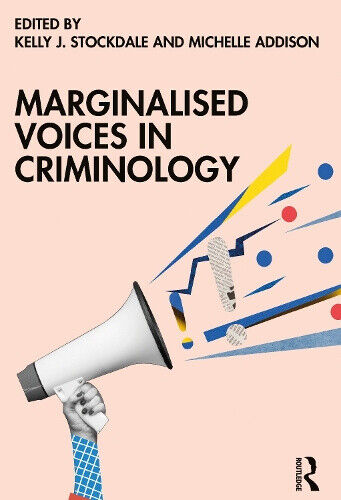
My colleague from Durham University, Stephen Ashe and I co-published Chapter 3 titled Engaging Indigenous Australian Voices: Bringing epistemic justice to criminology? in an amazing book collection called Marginalised Voices in Criminology. This book was edited by Kelly J. Stockdale and Michelle Addison. The collection presents an alternative canon of criminological thought and is structured around three themes 1) Criminological theory, 2) Marginalised voices in criminology, and 3) Perpetuating marginalisation.
Chapter Abstract
As Amanda Porter, from the Brinja clan of the Yuin nation on the South Coast of New South Wales (NSW), Australia, has noted, the publication of Indigenous Criminology (Cunneen & Tauri, 2017) coincided with ‘a series of scandals and mounting inquiries into Indigenous justice issues around the globe’ (2019: 122), including rising levels of Indigenous incarceration. What is more, in reviewing Indigenous Criminology, Porter called on criminologists to ‘ask some unsettling questions’, namely:
[H]as criminology as a discipline failed Indigenous peoples? And, if so, how can we do things differently? To what degree has criminology been complicit in the rising rates of Indigenous incarceration internationally? And what, if anything, does criminology have to offer the crises in criminal justice which have been the experience of Indigenous peoples around the globe? (2019: 122).
These questions are particularly pertinent given that Indigenous communities around the world have endured a fraught history in terms of their relationship with academic researchers in Western institutions – finding themselves essentialised, pathologised, marginalised and, until the late twentieth century, explicitly excluded from tertiary institutions. In doing so, Western research practices have tended to disempower Indigenous peoples, and problematise Indigenous beliefs and cultural practices. This has been evident throughout the development of criminology as a field of study, where Indigenous voices continue to be routinely sidelined. This has led criminologists Chris Cunneen, a non-Indigenous Australian scholar, and Juan Marcellos Tauri, a Māori scholar of the Ngāti Porou iwi of Aotearoa (New Zealand), to question whether American and European criminological traditions can provide an adequate starting point for understanding Indigenous peoples’ contact with criminal justice systems in White settler-colonial societies (Cunneen & Tauri, 2017).
In this paper, we argue that mainstream criminology has subjected Indigenous scholars, and peoples more generally, to forms of ‘epistemic injustice’ (Fricker, 2007) and ‘epistemic positioning’ (Bacevic, 2021). Not only this, when considered alongside the other marginalised voices explored in this collection, we suggest that the field of criminology has drifted into a state of ‘disciplinary decadence’ (Gordon, 2015). Despite this, Indigenous scholars have long made significant contributions to decolonising the academy, ways of approaching questions of justice, and pragmatic processes which look to embed Indigenous perspectives in research practices. Alas, they have been overlooked, if not ‘willfully ignored’ (Mills, 1997/2007, Alcoff, 2007; Pohlhaus, 2012). Thus, this chapter will contribute to ongoing efforts to address these injustices by drawing attention to Indigenous Australian contributions to criminological theory, with particular emphasis placed on highlighting the scholarship of Indigenous women who have found themselves marginalised as a result of the intersection of Indigeneity and patriarchy. Moreover, by celebrating the work of Indigenous women and their allies, this chapter points towards ways in which the aforementioned forms of epistemic injustice and positioning might be repaired.