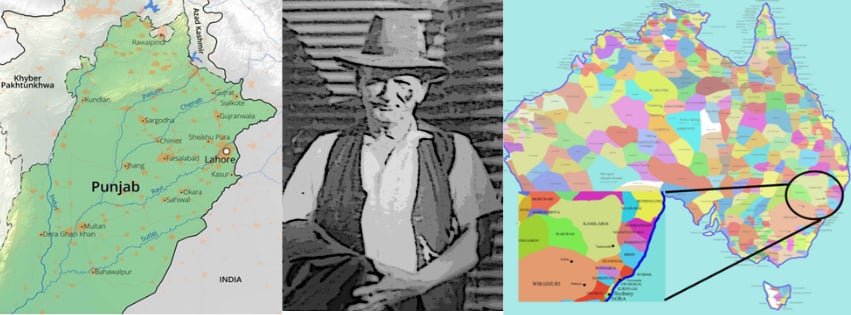
Family history is more than just tracing names on a family tree—it’s about uncovering the deep, interconnected narratives of migration, identity, and belonging. The Quest for Bargallie: Mapping Our Roots and Routes, a collaborative research paper by me, Dr. Debbie Bargallie, and my colleague Awais Hussain, takes readers on a powerful journey through transnational genealogy, Indigenous and diasporic histories, and the enduring significance of relationality across time and space.
Published in the Journal of Global Indigeneity (Vol. 9, Issue 2, 2025), this paper documents research into my great-grandfather’s origins, tracing his migration from Punjab, India – now Pakistan – to Australia and his integration into Kamilaroi Country. Through oral histories, archival research, and DNA analysis, the authors examine the complexities of family history and transnational identity formation within the context of colonial migration policies.
A Story of Roots and Routes
My surname has long been a source of curiosity. My great-grandfather, Thomas Bargallie, arrived in Australia in the late 1890s from Punjab, India, and worked as a hawker before settling with Kamilaroi woman Rose Ethel Griffiths. The paper explores the intersections of migration, race, and kinship in early 20th-century Australia, focusing on how Punjabi migrants like Bargallie navigated exclusionary policies and created familial and economic networks.
Rather than merely tracing lineage, the paper documents how genealogical inquiry can uncover broader historical patterns. It highlights the roles of oral history, documentary evidence, and genetic genealogy in reconstructing family narratives. The research also sheds light on the racialised experiences of Indian migrants in Australia, their interactions with Indigenous communities, and the complexities of identity shaped by colonial structures.
Decolonising Genealogy
Western genealogy often prioritises written records and Eurocentric frameworks, but The Quest for Bargallie integrates Indigenous methodologies and relational approaches to reconstruct a history that has often been overlooked in official archives. The authors incorporate oral traditions, community narratives, and critical race scholarship to provide a more nuanced understanding of familial histories.
Through this lens, genealogy is positioned as a collective and ongoing process of rediscovery. The paper emphasises relationality—where identity is not just about lineage but also about cultural memory, kinship, and place-based belonging.
Looking Ahead
As part of the ongoing Punjabi Dreaming project, this research sets the stage for future investigations into transnational kinship, migration, and the cultural continuities between Punjabi and Aboriginal communities. We visited Punjab, Pakistan to undertake further research in late 2024 – while the Quest for Bargallie article was in publication – where we engaged with family networks and archival sources to deepen the story of Bargallie and his biraderi.
Read the Full Paper
This paper reports on the research undertaken before the Punjab, Pakistan trip. The visit will be reported in a follow-up paper.
This research is a must-read for those interested in Indigenous studies, transnational migration, and decolonial approaches to family history.
You can access The Quest for Bargallie: Mapping Our Roots and Routes in the Journal of Global Indigeneity here:
Stay tuned for more updates on this journey of reconnection and rediscovery.