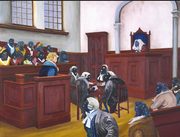
Legal scholar Jennifer Nielsen and I published Chapter 9 titled Commissioner of Corrective Services v Aldridge (No. 2) [2002] NSWADTAP 6 in a new book: – Indigenous Legal Judgments: Bringing Indigenous Voices into Judicial Decision Making edited by Nicole Watson and Heather Douglas. This book was published in June 2021 by Routledge and is a collection of key legal decisions affecting Indigenous Australians, which have been re-imagined so as to be inclusive of Indigenous people’s stories, historical experience, perspectives and worldviews
Dr Nielsen and I chose to rewrite a 2002 NSW Administrative Decisions Tribunal judgment, Commissioner of Corrective Services v Aldridge as an Appeal judgment heard by the NSW Court of Appeal. The case concerns Richard Aldridge’s complaint of race discrimination against the NSW Department of Corrective Services, in relation to his removal from a position leading the Department’s response to the recommendations of the Royal Commission into Aboriginal Deaths in Custody (‘RCIADIC’).
We came to this work as situated knowers of and having experienced the culture and operations of the prison system and been ethical witnesses to its institutional toxicity, especially to Indigenous Australian peoples as prisoners, families, and employees. We used critical race storytelling and the Indigenous method of Yarning (Bessarab and Ng’andu, 2010) to exchange our knowledge and stories as Indigenous and non-Indigenous researchers and share our personal and academic understanding of Aldridge’s case.
Drawing especially on the works of Professor Aileen Moreton-Robinson and Professor Irene Watson, our rewritten judgment privileged Indigenous voices thereby changing whose voices are central in this legal narrative. Our rewritten judgment brings vital attention to what is said and to what was not said in the original decisions through centring Richard Aldridge’s knowledge and lived experience of racism.
Read our chapter below: